Webinar: Understanding HIV testing in England 

National HIV Testing Week is a key moment to raise awareness, reduce stigma and make it easier for people to access an HIV test. It’s also an opportunity to understand what’s working, identify changes in testing trends, highlight gaps where more effort is needed and explore ways to further improve access to testing. 

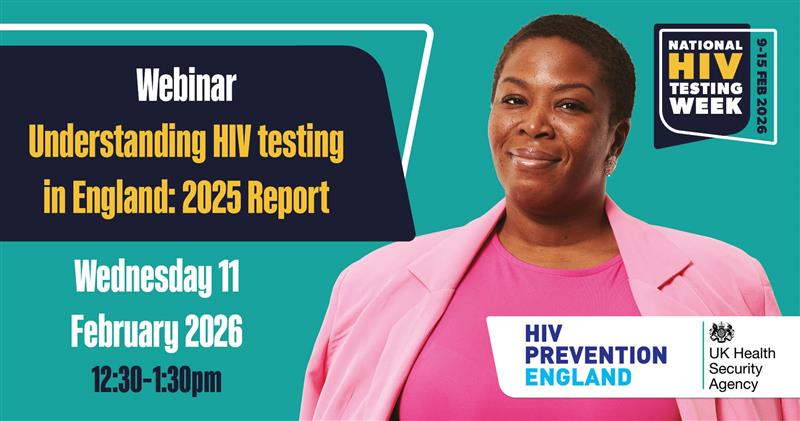
On Wednesday 11 February 2026 (12:30-13:30pm), HIV Prevention England is hosting a webinar presented by Dr Alison Brown, Consultant Scientist at the UK Health Security Agency (UKHSA), on the findings from the UKHSA’s Understanding HIV testing in England: 2025 report. The session will explore what latest surveillance and service data tells us about HIV testing in England across a range of settings and consider the implications for commissioning, community action and service optimisation. 

Register:  HIV Prevention England: Understanding HIV testing in England 2025 report  

Why this webinar matters 

Making HIV testing accessible is pivotal to achieving the HIV Action Plan’s goal of ending HIV transmissions in England by 2030.  

Understanding how testing is being delivered and where barriers persist helps us all target efforts where it will have the greatest impact. 

The UKHSA’s Understanding HIV testing in England: 2025 report provides the most comprehensive analysis of testing activity and outcomes across different routes and services. Expect discussion of what the data suggests about reach, coverage and variation, as well as what should be considered to expand and improve access to testing, particularly for target groups and in locations where testing uptake remains lower. 

Who should attend 

This session is aimed at: 

  • Clinicians working in and alongside sexual health, primary care, emergency care and other relevant services 
  • Commissioners and system leaders planning pathways, resources and local HIV testing and prevention strategies 
  • Community organisations supporting testing, outreach and engagement 

Whether you deliver tests directly, commission services, or support communities to access care, this webinar will provide valuable insights to inform and support your work. 

What we’ll cover 

The webinar will explore: 

  • What the report shows about where HIV testing is happening across England 
  • Insights into variation and inequalities in testing access and outcomes
  • What the findings imply for service design, commissioning and partnership working 
  • Practical considerations for improving reach and strengthening routes into care 

There will be an opportunity to ask questions during the session.  

Register

Register:  HIV Prevention England: Understanding HIV testing in England 2025 report  

Date: Wednesday 11 February 2026
Time: 12:30 until 13:30pm

If you’re involved in HIV prevention, this is a timely opportunity to hear directly from UKHSA, connect the national picture to local planning, and take forward actions that make testing easier, more routine, and more equitable. 

National HIV Testing Week kicks off Monday 9 February 2026

The next edition of National HIV Testing Week (NHTW) will run from 9–15 February 2026. NHTW is an annual campaign that promotes and encourages regular HIV testing across England. It is particularly targeted at groups most affected by HIV, including gay, bisexual and other men who have sex with men (GBMSM), and heterosexuals of Black African ethnicity.

People will be encouraged to order a free HIV test kit from freetesting.hiv or to get tested in any other way that is convenient for them.

The campaign will use the tagline “I Test”, with a variety of sub-messages reflecting people’s different motivations for testing. Featuring a diverse range of models to resonate with and represent the target audiences, the campaign will run across outdoor advertising, targeted broadcast, digital and social media, press and PR.

Get involved


HIV test kit distribution in barbershops and hair salons for National HIV Testing Week

Barber in front of barber shop

People of Black African ethnicity are one of the groups disproportionately affected by HIV in England, according to surveillance data from the UK Health Security Agency. An estimated 1600 people of Black African ethnicity are estimated to be living with undiagnosed HIV in England, making up 34% of the estimated total of 4700 people. This is disproportionate when considering that people of Black African ethnicity made up less than 3% of the UK population in the most recent census.

To help address this, during National HIV Testing Week, HIV organisations are working together to make HIV testing easier to access – including by making it possible to pick up free tests in barbershops and hair salons. The organisations involved are the African Institute for Social Development (AISD) in Nottingham, Yorkshire Mesmac in Leeds, the African Advocacy Foundation in London, and Terrence Higgins Trust, which are co-ordinating the national campaign.

Why barbershops and hair salons?

It is well documented that barbershops and hair salons are pivotal in Black communities as hubs where people share stories and discuss issues affecting their communities. HIV Preventions England’s partner organisations piloted this initiative during National HIV Testing Week 2024, and it was successful at opening up conversations about HIV amongst individuals who had not recently considered getting tested for HIV.

Following the successes of the COVID-19 vaccination programme, initiatives to educate people about other health conditions via barbershops and hair salons have been expanding. Hypertension testing is also being implemented in barbershops in various parts of the country.

By raising the issue of HIV testing in barbershops and hair salons, we facilitate conversations that might not usually happen as there is vast evidence that people in the community tend not to talk about it because of the stigma of HIV.

Juddy Otti of the Africa Advocacy Foundation said,

“Providing testing in Black community barbershops and hair salons is crucial because these spaces are more than just places for grooming—they are trusted cultural hubs where real conversations happen. By bringing health screening services into these familiar environments, we break down barriers to access, encourage early diagnosis , and empower communities to take ownership of their well-being.”

Amdani Juma of the AISD, added that:

“Community barbershops in Nottingham City and surrounding areas have been part of HIV and sexual health prevention work for more than decade. They are trusted by their regular customers and most people discuss freely about sex, politics and football matches in barbershops. People can be as loud as they wish to and most of the time people exchange views and opinions without fear of being judged. People find barbershops liberating that’s why we have been successful in introducing National HIV Testing Week. “

HIV self-testing kits

HIV self-testing kits provide results that the individual can read without sending them to a lab for analysis. For this initiative, people will be given the option of using either a finger prick test or an oral swab test. The finger prick test will give a result in 15 minutes, and the oral swab test will provide a result in 20 minutes.

During National HIV Testing Week, anyone in England can also order a free HIV test, which they can do at home via freetesting.hiv. The test arrives in plain packaging, and testing for HIV is free, easy, quick and confidential.

This project is supported by  Newfoundland Diagnostics and Invitech Ltd, the licensed distributors of OraQuick HIV tests in the UK.